The Wright Brothers’ First Flight: The Moment Aviation Was Born
At the edge of a lonely dune in North Carolina in December 1903, two brothers from Dayton, Ohio, defied the impossible. They had no formal engineering training, no government funding, and no certainty of success. But Orville and Wilbur Wright believed in flight, and on a cold morning at Kitty Hawk, their vision finally left the ground. The photographs from that moment are more than technical documentation — they’re a visual record of one of the greatest leaps in human history.
The Dream of Flight Becomes Reality
The Wright brothers’ journey was a combination of curiosity, courage, and methodical problem-solving. They tested gliders on the windswept beaches of the Outer Banks for years, learning from each failure and adjusting their designs. Their chosen site — Kitty Hawk — offered consistent winds and soft sand, perfect for early experiments.
On December 17, 1903, the Wright Flyer became the first powered, controlled, and sustained heavier-than-air machine to fly with a pilot aboard. Orville took the controls for the maiden flight, flying 120 feet in 12 seconds, with Wilbur running alongside. There were four flights that day, each captured in grainy black-and-white images that soon circled the world.

The 1903 Wright Flyer on the sandy field at Kitty Hawk before flight, 1903. Public Domain. Wikimedia Commons

Wilbur Wright and helpers prepare for an early flight at Kitty Hawk, with the Flyer in the background, 1903. Public Domain. Wikimedia Commons

The Wright Flyer lifts off the ground at Kitty Hawk, the world’s first powered flight. Photo by John T. Daniels, 1903.Photo: Wright Flyer in flight, 1903. Public Domain. Wikimedia Commons
Trials, Triumphs, and the Evolution of the Flyer
The early successes at Kitty Hawk were just the beginning. The Wrights continued to improve their designs, adding controls for pitch, roll, and yaw, and experimenting with stronger engines and better propellers. Not every flight was a success — the brothers faced crashes, rough landings, and skepticism from the press.
On December 14, 1903, three days before the famous flight, the Flyer toppled after a failed launch attempt. These moments of adversity were meticulously photographed, leaving behind a visual record of both disaster and determination. By 1905, their Flyer III was capable of sustained, controlled flight, circling a field and inspiring the next wave of aviation pioneers.

Wright Flyer on the track at Kitty Hawk, before an unsuccessful flight. Photo attributed to Wilbur Wright (1867–1912) and/or Orville Wright (1871–1948). 1903. Photo: Wright Flyer on launch track before failed attempt, December 14, 1903. Public Domain. Wikimedia Commons

Wright Flyer III in flight over an open field. Photo by Wilbur Wright, 1905. Photo: Public Domain. Wikimedia Commons

Early demonstration flight of the Wright Flyer before a crowd, 1910. Photo by Dutch National Archives. CC0 1.0 PD. Wikimedia Commons
The Legacy of Kitty Hawk: How the World Changed
What the Wright brothers achieved at Kitty Hawk in 1903 rapidly echoed across the globe. Soon, they were invited to demonstrate their flying machines in America and Europe. Crowds flocked to see the miracle of powered flight, and inventors everywhere scrambled to build their own versions. Aviation quickly evolved — from experimental gliders to practical vehicles for transport, commerce, and even warfare.
Photographs of later Flyers show further improvements: larger wings, stronger structures, and more confident pilots. The Wrights themselves became celebrities, but they never lost their dedication to engineering and discovery. Their work laid the foundation for everything from commercial airliners to modern drones.

Wright Flyer III flying near Kill Devil Hills, North Carolina, 1905. Photo attributed to Wilbur and/or Orville Wright. Photo: Public Domain. Wikimedia Commons

Close-up of the Wright Flyer’s engine and frame at Kitty Hawk. Photo most likely taken by Orville Wright., 1903. Public Domain. Wikimedia Commons

Orville Wright and Lt. Thomas Selfridge seated in the Flyer before a test flight. Photo by U.S. Army Medical Museum, 1908. CC BY 2.0. Wikimedia Commons
The Flight that Launched a Century
The grainy photographs of the Wright brothers’ first flights still inspire wonder. In every image, you can see the courage, struggle, and hope of inventors who refused to give up. Their journey from bicycle mechanics to global icons reminds us that innovation can come from the humblest beginnings.
Today, every commercial airliner, every space rocket, and every drone owes something to that windswept morning at Kitty Hawk. The Wright brothers’ achievement was not just the birth of aviation—it was a new way of seeing the world.
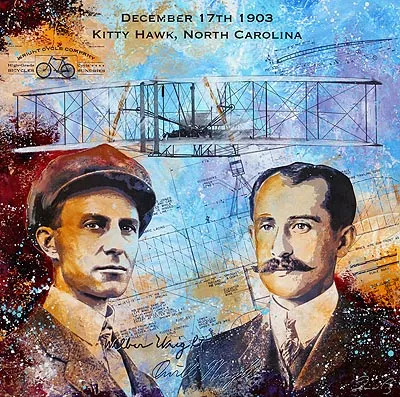
Modern artwork showing the Wright brothers, their Flyer, and the spirit of invention. Image by Bernd Luz. CC BY-SA 4.0. Wikimedia Commons




_thin.jpg)


,_National_Museum_of_Health_and_Medicine_(3323202385).jpg)